• Skip to main content
  • Skip to header right navigation
  • Skip to site footer
  • DONATE
  • SHOP
The Land Between

The Land Between

Explore - Learn - Inspire

  • About
        • Our Story
          • Our Goals
          • How We Operate
          • Staff and Council
          • Our Impact
          • Join Our Team
          • Partners and Supporters
        • About The Land Between Bioregion
          • Sacred Ecology
          • Natural Habitats
          • Wildlife & Species At Risk
          • People and Place
  • Projects
    • Blue Lakes
    • Working Watersheds
    • Turtle Guardians
    • Bird Buddies
    • Agwaamtoon Mshkiikii – Protecting Medicines
    • Native Gardens
    • Special Projects
  • Learning Centre
    • Consultation, Engagement, and Honouring Our Shared History
    • Living in the The Land Between
    • Invasive Species: Phragmites
    • Knowledge Circles
    • Community “Talks”
    • Regional Research
  • Get Involved
    • Wildlife Diary- Report a Species
    • Volunteer Nature Monitoring
    • Shop The Store
    • Donate
    • Work With Us
  • News & Events
    • Upcoming Events
    • Camps
    • TLB Blogs
    • The Skink Newsletter

Pugnose Shiner

(Notropis anogenus)

Status: Threatened (ESA 2014, COSEWIC 2013)

Table of Contents:

  • Species Identification
  • Diet
  • Habitat and Range
  • Biology and Behaviour
  • Similar Species
  • Threats/Reasons for Being at Risk
  • Conservation and Recovery Strategies
  • How You Can Help
Pugnose Shiner
Pugnose Shiner ID

Species Identification:

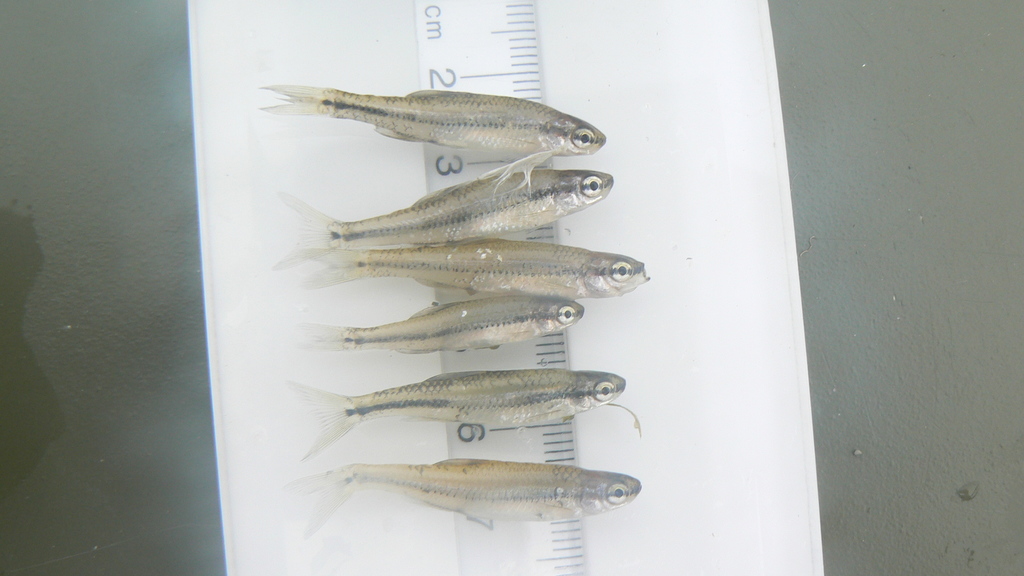
The Pugnose Shiner is a member of the minnow species, only reaching lengths of about 5-6 cm. They are silver with pale yellow or olive markings and a dark stripe along the sides of their body from snout to tail. They have pale, translucent fins and an upturned mouth.

Diet:

Pugnose Shiners mainly feed on aquatic plants, green algae, plankton, small leeches, and some aquatic insects. They generally feed near the bottom amongst vegetation to stay hidden from predators.

Back to top of page

Photo by Eric C. Maxwell: https://www.inaturalist.org/observations/86307296
Map taken from Government of Canada: https://www.canada.ca/en/environment-climate-change/services/species-risk-public-registry/cosewic-assessments-status-reports/pugnose-shiner-2013.html#_01_2

Habitat and Range:

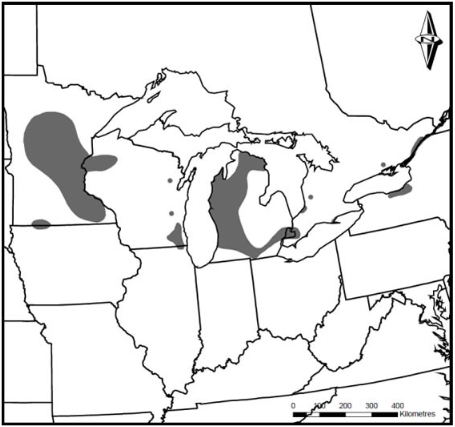
This species is generally found in two main water systems in central North America, which are the Mississippi River system and the Great Lakes basins. In the Mississippi River system, they are found in Illinois, Wisconsin, and Minnesota. They are also found Lake Michigan, Ontario, Huron, Erie, and St. Clair, as well as the St. Lawrence River. The Pugnose Shiner is Extirpated in Ohio, North Dakota, and declining in Michigan. In Canada, the Pugnose Shiner is only found in Ontario. The Pugnose Shiner may be found in The Land Between in the St. Lawrence River systems as well as the Trent River, but sightings have been rare. 

In the United States, Pugnose Shiners are commonly found in clear, slow moving water that is heavily vegetated with species like pondweed, milfoil, bulrush, and algae. They prefer substrate with sand, mud, or gravel. In Canada, Pugnose Shiners prefer clear, slow moving waters of large lakes, channels, or large rivers that have sand or silt bottoms with plenty of submergent vegetation. Clear water with plenty of vegetation is a must for this species, making turbidity (the measure of clarity in water) a huge issue.

Back to top of page

Biology and Behaviour:

Since Pugnose Shiners are a relatively small and elusive species, little is known about their biology and behaviour. They do not travel very far in their lifetimes, so spawning generally occurs nearby in shallow water with dense vegetation. Spawning most likely happens from mid-May to July depending on water temperatures (they prefer 21-29°C). Females have between 500 and 1300 eggs, but all of them may not be laid or fertilized in one season. Like most fish species, females will lay their eggs amongst the vegetation and silt, and males will fertilize them. Pugnose Shiners are thought to reach sexual maturity at the age of 1 and live to a maximum age of 3. They will inhabit shallow waters during the spring and summer, and overwinter in deeper water. They have a wide range of predators like larger fish species and various bird species.

Photo by Matthew Tobey: https://www.inaturalist.org/observations/97253832

Similar Species:

The Pugnose Shiner is very similar in appearance to all other Shiner species in Ontario. These species include the Blackchin Shiner, Blacknose Shiner, Bridle Shiner, Striped Shiner, and Common Shiner.

Back to top of page

Threats/ Reasons for being at Risk:

1. Habitat loss and degradation: Habitat loss and degradation from shoreline development and shoreline erosion destroys the littoral zone (the part of a water body close to the shore) and impacts macrophyte communities, which are primary producers and can cause a chain reaction of species loss. Cottagers along lakes and rivers have also been known to clear away vegetation along the shores of their property for aesthetics, which is also contributing to habitat loss since Pugnose Shiners rely heavily on dense vegetation. 

2. Sediment and nutrient loading: Turbidity is one of the major threats to Pugnose Shiner habitat, since they rely heavily on clear water. Shoreline development and agriculture has been known to increase sediment and nutrient loading, both of which turn the water murky and reduce visibility.

3. Changes in aquatic vegetation: Changes can occur either from loss of aquatic vegetation, or the introduction of invasive species, both of which impact the Pugnose Shiner. Vegetation loss can occur from shoreline development, dredging, or increased recreational boating and activities. Vegetation loss means that the Pugnose Shiner no longer has suitable hiding, spawning, or food sources. On the other hand, the introduction of invasive species like non-native milfoils like the Eurasian Water Milfoil can cause dramatic changes in vegetation composition.

Pugnose shiner

Conservation and recovery strategies:

The Pugnose Shiner and their habitat is protected in Ontario and efforts have been made to produce a recovery strategy. The goals of this strategy are to determine current and ideal population numbers, determine and protect current habitat, evaluate and minimize current threats, investigate whether Extirpated populations can be recovered, and improve public education and awareness.
Back to top of page

How can you help?

  1. Report any sightings of the Pugnose Shiner to The Land Between, iNaturalist, or the Natural Heritage Information Centre. 
  2. Keep the shoreline on your property natural and free of chemicals.
  3. Get in touch with local organizations and government agencies to help protect your local watersheds. 
  4. Participate in citizen science shoreline and water rehabilitation projects with local organizations.
  5. Do not release any invasive species into the wild, and make sure you are not relocating any aquatic invasive species when travelling from one area to another.
  6. Drive slowly when travelling through rivers or in shallow lake areas.

Additional Resources:

  • Government of Ontario Pugnose Shiner Species at Risk page
  • Watersheds Canada Pugnose Shiner Landowner Engagement and Shoreline Habitat Restoration Project
  • COSEWIC 2013 Assessment and Report on the Pugnose Shiner
Photo by Scott Gibson: https://www.inaturalist.org/observations/7631805

Sources:

Government of Ontario. 2014. Pugnose shiner. Retrieved from: https://www.ontario.ca/page/pugnose-shiner

COSEWIC. 2013. COSEWIC assessment and status report on the Pugnose ShinerNotropis anogenus in Canada. Committee on the Status of Endangered Wildlife in Canada. Ottawa. x + 32 pp. https://www.canada.ca/en/environment-climate-change/services/species-risk-public-registry/cosewic-assessments-status-reports/pugnose-shiner-2013.html#_01_2

Back to top of page

Interested in learning more about Aquatic Species? Check out our blogs!
IMG_2443

The Essential Link Between Lake Health, Calcium, Forests and Forest Floor Ecology

March 1, 2023

The amount of calcium (Ca) in our freshwater lakes is seeing a major reduction. This is due to the lack of calcium in our forest floor from acid rain and …

Read More
Jaclyn SAR backgrounds

Wetlands are Wonderous

October 24, 2022

Written by Jaclyn Adams There are four different types of wetlands in The Land Between: bogs, fens, swamps, and marshes. Within The Land Between, 14% of the area are wetlands, …

Read More
Kennebec Wetlands square

Kennebec Wetlands Are The Best

June 13, 2022

Recent media attention has reported that a study by environmental scientists Cheng and Basu at the University of Waterloo has found that smaller wetlands are more beneficial to the landscape …

Read More
Cattails (1)

Cattail Tales

June 10, 2022

The Land Between and most of eastern Ontario has been redesigned by our road managers and by cattails. The landscape is now mapped and marked by lines of cattails following …

Read More
Canadian Sheild

What’s an “Ecotone”?

August 9, 2021

The striking physical features of the Canadian Shield ecosystem, known for bare outcrops of granite rock, of small lakes and thin layer of soil contrast with the St. Lawrence Lowlands …

Read More
grayling

Lessons From the Graylings of Red Chalk Lake

May 31, 2021

At The Land Between, stories are important to us.  Stories are great at sharing knowledge between generations and individuals.  This particular story comes from my Grandfather who was born and …

Read More
Phrag (2)

What the Phrag?! All You Need to Know About Invasive Phragmites

January 28, 2021

Phragmites australis australis, otherwise known as European Common Reed or Invasive Phragmites, is a fast-spreading, perennial aquatic grass found growing in wetlands, shorelines and roadside ditches. This aggressive plant crushes …

Read More
Common-Loon-2 (2)

Are We Losing the Loons?

January 9, 2021

What is Happening to Our Loons in Ontario?   The Common Loon (Gavia immer) is Ontario’s provincial bird and a well-known character in cottage country – its mournful wails and …

Read More
eurasian milfoil

Clogging the Lakes: Eurasian Watermilfoil

November 27, 2020

Understanding Eurasian Watermilfoil: What is it, How Did it Get Here, What are its Impacts, and What Can We Do to Prevent its Spread? What is Eurasian Watermilfoil? Eurasian Watermilfoil …

Read More
Beaver with stick

Busy Beavers, Our Essential Ecosystem Engineers

November 3, 2020

Beavers are easily one of the most fascinating and unique creatures in our landscape with their impressive paddle-like tails, lush shiny fur, self-sharpening teeth, and ear and nose valves that …

Read More


  • Home
  • The Region
  • The Charity
  • Shop
  • Donate


The Land Between is a National Charity #805849916RR0001.

Your support helps us celebrate, conserve, and enhance this important region. You can reach us at:

P.O. Box 1368, Haliburton, ON K0M 1S0
705-457-1222 | info@thelandbetween.ca

We respectfully acknowledge that The Land Between is located within Williams Treaty 20 Mississauga Anishinaabeg territory and Treaty 61 Robinson-Huron treaty territory, in the traditional territory of the Anishinaabeg. We respectfully acknowledge that these First Nations are the stewards and caretakers of these lands and waters in perpetuity and that they continue to maintain this responsibility to ensure their health and integrity for generations to come.

Copyright © 2022 The Land Between