

Status: Threatened (Ontario 2013, SARA 2017)
Species Identification:
The bank swallow is a small bird (12-14 cm in length with a wingspan from 25-33 cm) with a dark brown back and white throat and belly. Bank swallows have a defined brown band across their chests (close to the neck area) and also usually have a brown strip that goes almost halfway down the middle of their chests. Unlike more showy species, males and females are the same size with similar colouring. Bank swallows have characteristicly fast wing "beats" which together with their small stature, makes them uniquely identifiable from other swallows. These beauties are often seen roosting on telephone wires, so keep an eye out and you might be lucky enough to see one!
Diet:
Bank swallows are insectivores, meaning that they only eat insects. Bank swallows mainly catch prey during flight, diving quickly over open areas (such as water and open fields) to acquire their meals. Their diet changes depending on their life stage with nestlings mainly consuming flies while adults feed on ants, flies, bees, wasps, beetles and other flying insects. Interestingly, they have been found to occasionally eat spiders and aquatic invertebrates.

Biology and Life Cycle:
Bank swallows nest in colonies of up to several thousands, however in Ontario the average colony contains only 45 pairs (an extremely low number compared to historical data).
The average age of breeding birds is 1.7-2 years, however bank swallows reach sexual maturity before their first birthday. In Ontario, breeding season extends from May to August, with different groups arriving to the breeding grounds at different times (typically the older birds arrive first, with the younger birds coming a few weeks later).
In natural habitats, bank swallows dig tunnels into sandy bluffs or eroding river banks to build their nests (hence their name bank swallow). In anthropologically (human) modified areas, they use both natural and human-made features for nesting including: aggregate pits, soil stockpiles, and roadsides. Bank swallow's burrow are almost always excavated in a vertical or near-vertical banks at low elevations (<900 m). Males excavate these burrows to make nesting cavities that are typically 59-90 cm deep. Males which create their burrows in sediment with the fine particles tend to have higher nesting success. This is because finer sediment allows them to make deep burrows which results in better protection of eggs and nestlings from predators.
After burrows are dug, females build the nests and lay an average of 5 eggs which they incubate for two weeks. Nestlings fledge after about three weeks, and will continue to use the burrow for another week. FUN FACT: bank swallows usually do not return to the exact same location to nest (less than 14% return).
Bank swallows have a relatively high rates of nesting success (this is an especially interesting fact considering their severe population decline). Some causes of nest failure are: banks collapsing, starvation, flea infestations, and predation. Many mammals, snakes, and bird species feed on bank swallow eggs while kestrels, martins, and several snake species prey on adults.
Presence in The Land Between
Habitat and Range:
The bank swallow is globally distributed, found in all continents except Antarctica and Australia. Within North America, they tend to breed south of the treeline in Canada and within the northern two thirds of the United States. After breeding season they migrate through the United States and Central America to South America where most of them over winter.
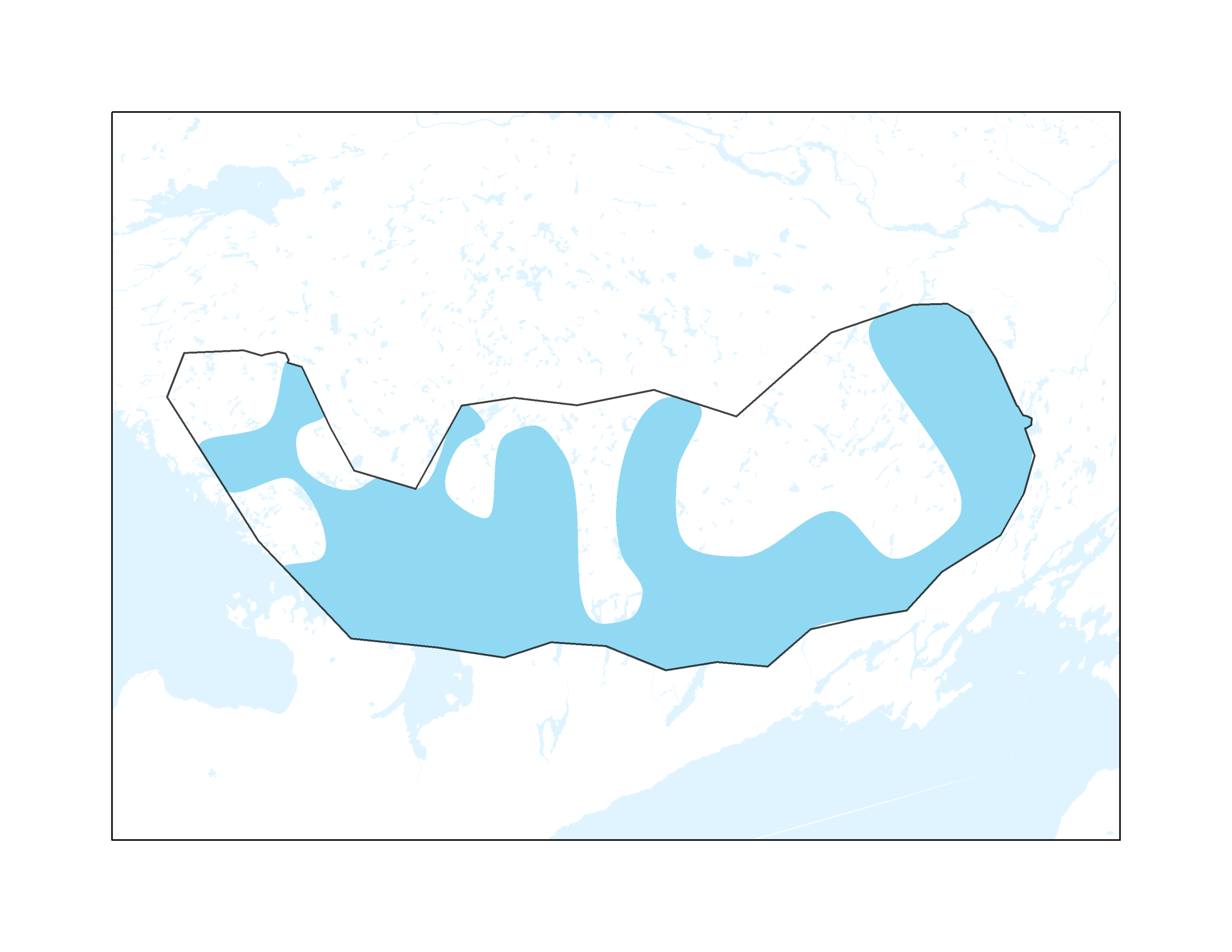
Bank Swallows are found across southern Ontario with sparse populations in the Hudson Bay lowlands and the highest concentrations in the southern Carolinian zone. In addition, several confirmed breeding pairs have been found in the Canadian Shield region and in the Land Between.
Bank swallows roost in large colonies on telephone wires, fences, or in trees, and feed over wide open areas such as grasslands, agricultural fields or open water. When migrating a range of lowland habitats are used: wetlands, fields, shorelines, savannas and estuaries. Listen to bank swallows calls here!
Threats/Reasoning for Being at Risk:
Bank swallow populations have experienced serve declines in the last 40-50 years, with reports of up to 98% reduction. Some of the major threats to bank swallow populations are listed below.
1. Accidental mortality during aggregate operations:
As many historical nesting sites have been lost, bank swallows are now nesting in man-made structures more and more. Piles of sand, gravel, or soil provide excellent habitat for bank swallow nests, but unfortunately, also greatly increase the risk of mortality due to crushing of nests, eggs, and young fledglings.
2. Loss of breeding habitat due to hydrology management: Since the colonization of North America, many streams have been channelized and dams installed, leading to significant drawn downs on water levels and diversions of water for use in agriculture. These changes to natural hydrological cycles have led to altered erosion patterns in many areas and a loss of natural bluffs. This has greatly reduced the natural nesting habitat available to bank swallows. Moreover, recent trends of using hard armouring, like cement, to buffer against flooding and erosion, has also been harmful to bank swallow populations (along with many other species) as it again reduces nesting habitat.
3. Suspected decline in insect populations: Pesticide use has caused declines in insect populations globally. This decline threatens many species that rely on insects for food such as bank swallows and even humans (we rely on pollinators for many of our favourtie foods). With high levels of pesticide use in both North and South America, banks swallows are likely facing a decline in food sources across their entire range. In addition, climate change also is exacerbating the effect by creating a temporal mismatch between insect and bird breeding cycles.
4. Road mortality: In some areas this is the largest threat to bank swallows during breeding season. The risk of collision is further amplified because bank swallows are attracted to dead swallows left on roads.
5. Loss of foraging habitat: Habitat is being lost that supports insect populations in their forging habitats such as wetlands, grasslands and wooded areas.
Current Conservation Efforts:
Provincial guidelines have been made to help aggregate producers deter bank swallows from nesting in piles. For example, ensuring aggregate piles have gentle slopes to deter bank swallows from nesting, or avoiding activity around known nesting sites.
Conservationists are also advocating to ensure that lakeshore development is set well back from water, cliffs, or eroding banks. They also encourage the restoration of rivers to natural hydrological states by restoring riparian areas and removing unnecessary infrastructure (like old channelizing structures, dams, and hard armouring- wall structures) or modifying them to new less invasive infrastructure.